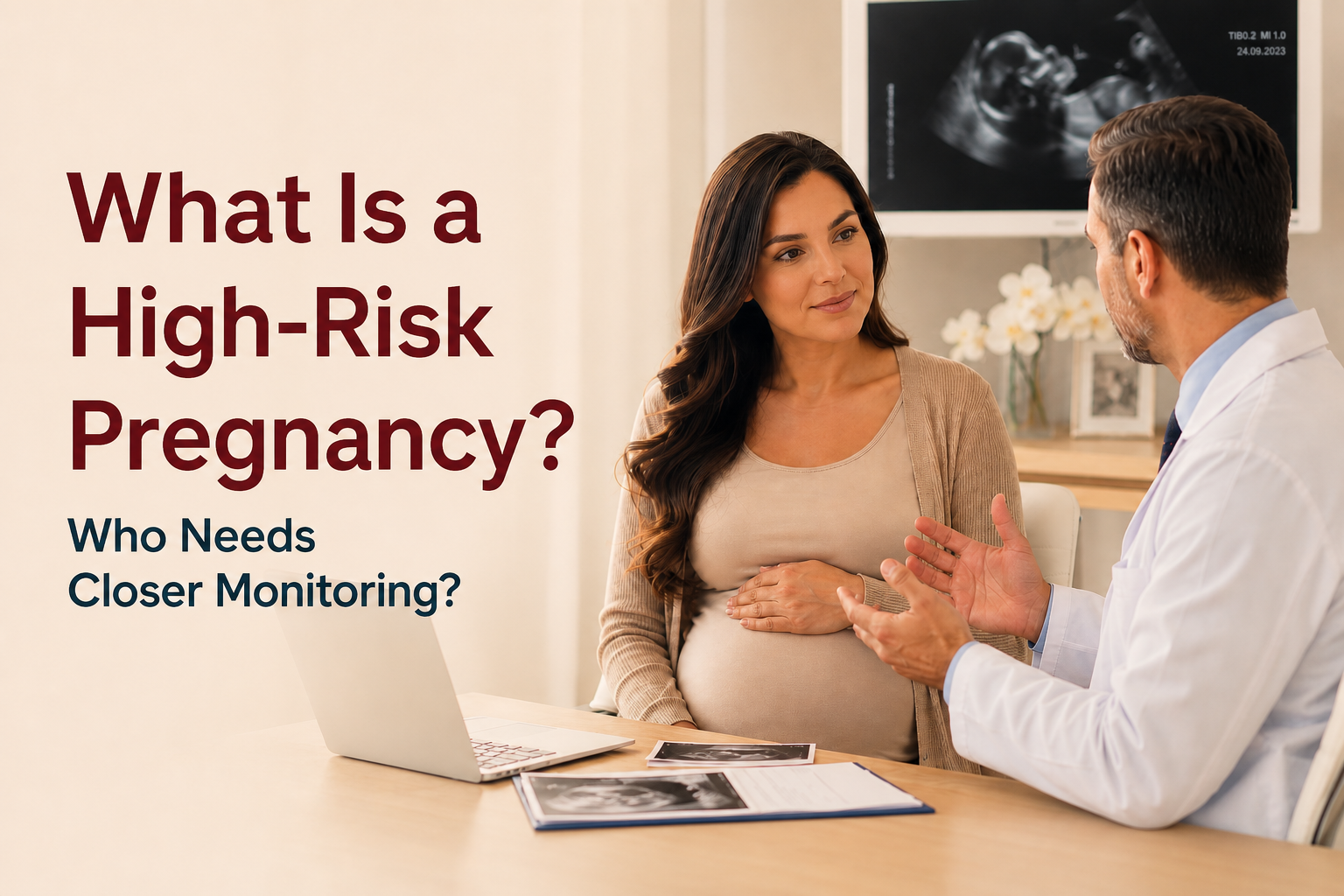
A high-risk pregnancy is the shared name for pregnancies that need closer, more specialized monitoring for the mother, the baby, or both. Risk is not a verdict — when it is recognized early, it is a situation that can be managed.
Summary
A high-risk pregnancy is the general term for a pregnancy in which some factor raises the chance of a complication above average. The label does not mean a problem is inevitable; it means the pregnancy is watched more closely. It can be linked to age, chronic conditions, a multiple pregnancy, or a previous pregnancy history — and when it is caught early, it can usually be managed safely.
In this article
- What does “high-risk pregnancy” mean?
- Who has a high-risk pregnancy, and who needs closer monitoring?
- When is a high-risk pregnancy diagnosed?
- When does a perinatologist step in?
- How often is a high-risk pregnancy monitored?
- How is daily life planned during a high-risk pregnancy?
- Is a vaginal birth possible with a high-risk pregnancy?
- Why is it important to look at the whole picture?
The word “risk” can land heavily, and for many women the first reaction to this label is anxiety. Yet its meaning in the clinic is far calmer — it simply says that a pregnancy deserves a closer look.
A high-risk diagnosis is not the herald of a bad outcome. Most of the time it describes a situation that calls for the mother and baby to be monitored more closely. Risk is not a fixed list of what will happen; it is a map of what to keep an eye on.
I have worked in perinatology (maternal–fetal medicine) for more than thirty-five years. In this article I explain, in plain language, what a high-risk pregnancy is, who needs closer monitoring, and why that monitoring matters.
What does “high-risk pregnancy” mean?
A high-risk pregnancy describes a pregnancy in which some factor raises the chance of a complication for the mother or the baby above average. The key word here is chance: the label does not mean a problem is certain — it means the pregnancy needs to be assessed more carefully.
Pregnancy is a natural process that reorganizes a woman’s body from head to toe. The heart pumps more blood, the kidneys work harder, and the hormonal balance and immune system reshape themselves. In most women the body adapts to these changes without trouble; in some cases, an underlying factor can strain that balance. That is exactly why close monitoring matters — the aim is not to step in after a problem develops, but to notice changes early and manage the pregnancy as safely as possible.
It is also worth saying that not every high-risk pregnancy is the same. They arise for different reasons and do not all carry the same level of risk. Some pregnancies need only a few extra checks; others call for more frequent assessment and for several specialties to work together. So what really matters is why a pregnancy needs closer monitoring and how that monitoring is planned.
Who has a high-risk pregnancy, and who needs closer monitoring?
The situations that call for closer monitoring arise for different reasons. They can be grouped into three: factors related to the mother, factors related to the pregnancy itself, and factors related to a previous pregnancy history.
Factors related to the mother
Pregnancy at age 35 or older
Diabetes
High blood pressure (hypertension)
Thyroid conditions
Autoimmune conditions, such as lupus and antiphospholipid syndrome
Heart, kidney, and other chronic conditions
Factors related to the pregnancy
Multiple pregnancy (twins, triplets)
Placenta covering the cervix (placenta previa)
Placenta attaching abnormally deep into the uterine wall (placenta accreta spectrum)
Restricted growth of the baby in the womb (intrauterine growth restriction, IUGR)
Factors related to a previous pregnancy history
Pre-eclampsia (once called toxemia of pregnancy)
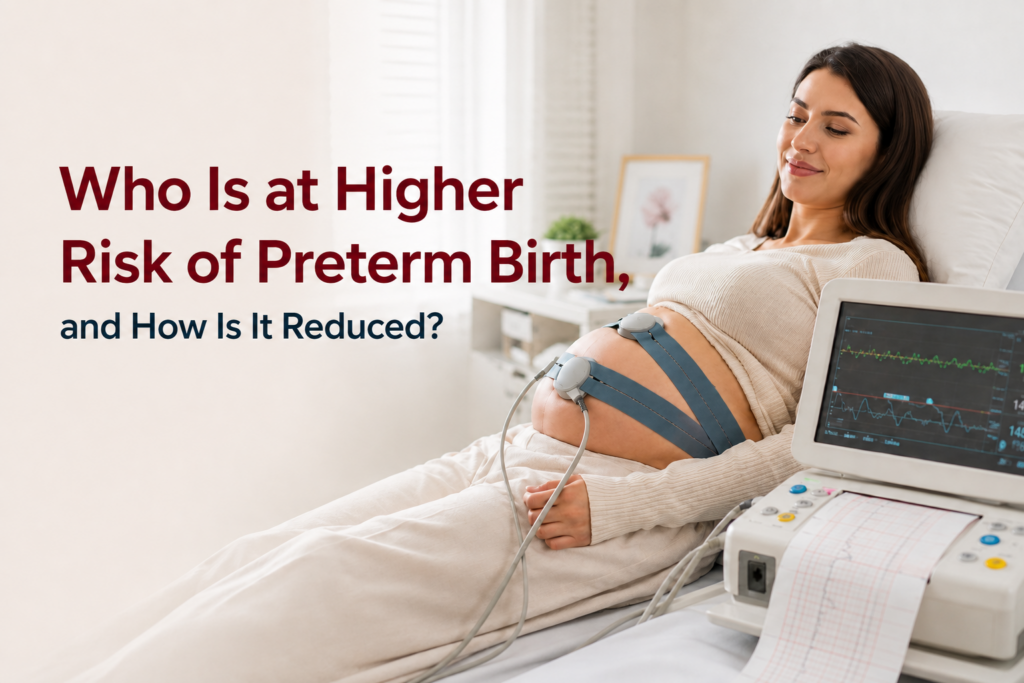
Preterm birth
Recurrent pregnancy loss
Cervical insufficiency (incompetent cervix)
Complications in a previous pregnancy
This is not a list of worries — it is a road map. Behind each item is an effective, evidence-based monitoring approach developed over many years.
When is a high-risk pregnancy diagnosed?
There is no single moment when a pregnancy is identified as high-risk. Some risks are known before pregnancy even begins; chronic conditions or a previous pregnancy history can shape the monitoring plan from the very first visit. That is why a pre-pregnancy assessment is valuable whenever it is possible.
Other risks show up in the early-pregnancy screenings, and some develop as the pregnancy progresses. Pre-eclampsia, for example, usually appears after the 20th week, while restricted fetal growth tends to become apparent in the second half of pregnancy. So the diagnosis does not belong to one single moment; as new information emerges over the course of the pregnancy, the monitoring plan is adjusted whenever needed.
When does a perinatologist step in?
Perinatology (maternal–fetal medicine) is a subspecialty of obstetrics and gynecology that focuses on high-risk pregnancies, assessing mother and baby together. Most pregnancies are safely followed by obstetricians; but some situations call for more detailed assessment, advanced ultrasound, or experience with high-risk pregnancy.
In managing a high-risk pregnancy, the biggest difference often comes from a timely referral. Sometimes an assessment carried out just a few weeks earlier can change how the whole pregnancy is managed — because the aim of perinatology is not only to manage problems once they appear, but to recognize possible risks early and carry mother and baby to the end of pregnancy as safely as possible.
How often is a high-risk pregnancy monitored?
Monitoring frequency is not the same for everyone; it is planned according to the reason for the risk, the stage of pregnancy, and the condition of mother and baby. For some pregnancies, adding a few extra assessments to the routine checks is enough; for others, the baby’s growth, blood flow, and the mother’s health are assessed at more frequent intervals. Close monitoring is often far less intrusive than people expect — regular checks mean that possible changes are noticed early and the necessary steps are taken in good time.
How is daily life planned during a high-risk pregnancy?
A high-risk pregnancy does not mean life comes to a stop. Many expectant mothers can keep working and carry on with their daily and social lives; what matters here is not blanket restrictions but a personal plan shaped around the specifics of the pregnancy. Questions such as nutrition, physical activity, and travel are assessed according to the reason for the risk. The goal is not to limit daily life unnecessarily, but to find the safest balance for mother and baby.
Is a vaginal birth possible with a high-risk pregnancy?
Yes — a high-risk diagnosis on its own does not mean a cesarean is needed. The mode of birth is determined by the reason for the risk, how the pregnancy progresses, the baby’s condition, and the assessment at the time of delivery. With the right timing and close monitoring, many high-risk pregnancies can end in a vaginal birth; the aim is always to choose the safest mode of delivery for mother and baby.
Why is it important to look at the whole picture?
In a high-risk pregnancy, the course is often shaped not by a single finding but by how the findings relate to one another. That is why the assessment is not reduced to a single heading; the mother’s health, her pregnancy history, and any accompanying conditions are considered as a whole.
One of the pregnancies I cared for illustrates this well. My patient had a history of recurrent pregnancy loss, and early in the pregnancy we had placed a stitch in the cervix (a cervical cerclage). At the same time, she had polycystic ovary syndrome, malabsorption following previous gastrointestinal surgery, nutritional deficiencies, and inflammation linked to a rheumatic condition. As the pregnancy progressed, the baby’s growth slowed and a risk of preterm birth emerged.
At that point, focusing on the baby’s growth alone would not have been enough. We assessed the pregnancy as a whole: while managing the risk of preterm birth, we worked to correct the nutritional deficiencies, bring the inflammation under control, and stabilize the underlying health problems. The result was a healthy birth.
This example is a reminder of the same truth: in a high-risk pregnancy, the biggest difference usually comes not from a single finding, but from the ability to look at the whole picture — taking root causes and the connections between systems into account together.
Frequently Asked Questions
Is every pregnancy at 35 or older high-risk?
No. Advanced maternal age may call for closer monitoring, but on its own it does not mean a high-risk pregnancy. What is decisive is whether another risk factor is also present and how the pregnancy is progressing.
Does a high-risk pregnancy always require a cesarean?
No. The mode of birth is determined by the specifics of the pregnancy, the reason for the risk, and the assessment at the time of delivery; many high-risk pregnancies can end in a vaginal birth.
Can you keep working and traveling during a high-risk pregnancy?
Most expectant mothers can carry on with daily life. Decisions about work and travel are made according to the reason for the risk, together with your doctor.
Close monitoring is not simply about more tests; its real purpose is to assess how the pregnancy is progressing in good time. A rise in blood pressure caught early, a slowing in the baby’s growth, or a change in the mother’s health can be managed while it is still a small issue.
That is why a high-risk diagnosis is not bad news but an opportunity to watch the mother and baby more closely; more often than not, it means a safer pregnancy and a healthier birth.
If you have learned that something in your pregnancy calls for closer monitoring, we can meet to review your situation in detail and build a monitoring plan that is right for you, together. This is a path we continue to walk with careful attention.
Author: Prof. Dr. Arda Lembet
Specialist in Obstetrics, Gynecology, and Perinatology. He completed his fellowship in high-risk pregnancy (maternal–fetal medicine) at Mount Sinai in New York. For more than thirty-five years he has cared for women’s health as a physician. In high-risk pregnancy, preterm birth, and recurrent pregnancy loss, he works with a root-cause-focused, whole-person approach — investigating the underlying causes and assessing women’s health not through a single complaint but as a whole, through the connections between systems.
Legal note
This content is for informational purposes only. For an individual medical assessment, please book an appointment with your doctor.