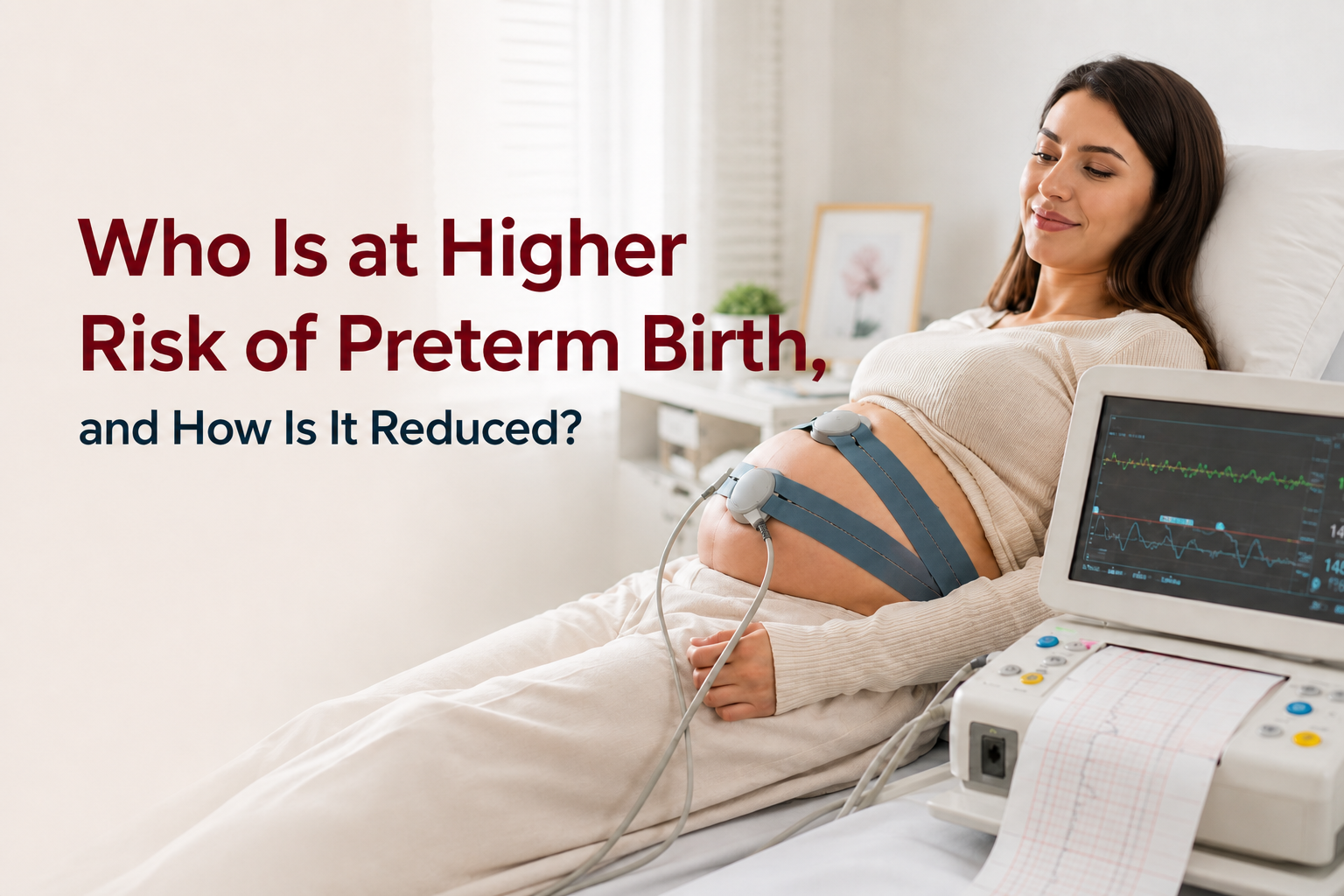
Preterm birth cannot always be prevented. But in many pregnancies the risk can be assessed ahead of time and, in suitable cases, reduced substantially with the right measures.
Summary
Preterm birth is a birth that happens before the 37th week of pregnancy. Conditions such as a previous preterm birth, a short cervix, and multiple pregnancy raise the risk. This risk can often be assessed in advance; in suitable cases, it can be reduced with progesterone, cerclage, and close monitoring. Not every pregnancy that looks high-risk ends in preterm birth.
In this article
- What is preterm birth, and when is it considered “early”?
- What are the symptoms of preterm birth, and when should you seek care?
- What raises the risk of preterm birth?
- Does a previous preterm birth recur in the next pregnancy?
- Can preterm birth risk be identified in advance?
- How is preterm birth risk reduced?
- What treatments are used in threatened preterm labor?
Preterm birth is far more common than people think. Worldwide, roughly one in ten babies is born before the 37th week of pregnancy is complete1,2. In Turkey the rate is even higher: according to Ministry of Health data, the preterm birth rate in 2022 was 12.9 percent3 — that is, about one baby in eight. Preterm birth is not a rare exception; it is a real possibility to keep in mind in every pregnancy.
Despite this frequency, the picture is not hopeless. Although not every cause of preterm birth is yet fully understood, recognizing the risk early, knowing the symptoms, and following a thoughtful plan can substantially reduce the likelihood of preterm birth in many pregnancies.
When people hear “preterm birth,” most picture a birth that begins suddenly. But preterm birth is often not a problem that appears at the moment labor starts; certain findings that can be seen earlier in pregnancy can give important information about the risk.
The most important truth I see in my clinical practice is that not every pregnancy thought to carry a risk of preterm birth is the same. What really matters is being able to tell apart, in good time, the pregnancies that truly carry a high risk and to plan the right monitoring. Many pregnancies that look high-risk can, with the right assessment and close monitoring, progress on time and in good health.
What is preterm birth, and when is it considered “early”?
Preterm birth is a birth that happens before the 37th week of pregnancy is complete. The earlier a baby is born, the less time there is for the organs to mature; that is why the week of birth is decisive for the baby’s health.
Preterm births are divided into subgroups according to the week of pregnancy in which they occur1:
Under 28 weeks — extremely preterm
28–31 weeks — very preterm
32–33 weeks — moderately preterm
34–36 weeks — late preterm
Babies in the last group — those born at 34–36 weeks — may seem close to babies born at term, but they are not entirely without risk. In these babies, breathing difficulty, feeding problems, low blood sugar (hypoglycemia), and jaundice can occur more often and call for careful monitoring.
Some preterm births begin on their own; others are carried out in a planned way because of the mother’s or baby’s health. The focus of this article is the risk of spontaneous preterm birth, which can be assessed in advance.
What are the symptoms of preterm birth, and when should you seek care?
When the following signs appear, you should see an obstetrician without waiting:
Regular, recurring contractions
Vaginal bleeding or spotting
Your water breaking — that is, the release of amniotic fluid
Increasing pressure and a feeling of fullness in the pelvic area
Marked, constant pain in the lower back
A sudden increase or change in vaginal discharge
A good many of these signs can also occur in pregnancies that are progressing without any problem. Mild contractions, pain radiating to the lower back, or changes in discharge are often perceived as an ordinary part of pregnancy; it is this very similarity that sometimes lets a real threat of preterm birth go unnoticed. So when you are unsure, it is best to ask for an assessment rather than wait. The belief that “once contractions start, there is nothing to be done” is not true; in some situations, an early assessment can make an important difference.
What raises the risk of preterm birth?
The risk of preterm birth is not the same for everyone; some conditions raise it markedly. These causes are sometimes factors that are directly related to the pregnancy and already known; sometimes they are less-known causes hidden in the mother’s general health.
What are the known risk factors?
At the head of all these factors, as the strongest and most decisive one, is a history of a previous preterm birth; such a history is the most important warning sign to take into account from the very first day of monitoring. Other important factors include a short cervix and cervical insufficiency. Past surgery on the cervix (conization, LEEP) can also raise the risk; and multiple pregnancies, such as twins and triplets, are among the most common causes of preterm birth. Intrauterine and genital infections, along with certain uterine anomalies, also contribute to this picture.
On the other hand, the absence of the strongest factor is no guarantee. Women who carry no obvious risk factor can also give birth preterm; in fact, a significant share of preterm births occur in pregnancies that carried no prior warning sign at all. That is why recognizing the symptoms is valuable not only for high-risk pregnancies but for everyone.
How does the mother’s health affect preterm birth risk?
The risk of preterm birth does not always stem from visible, pregnancy-related causes; sometimes the underlying cause is related to the mother’s general health. Thyroid conditions, metabolic imbalances, and certain hormonal states can affect the course of a pregnancy. Polycystic ovary syndrome (PCOS) is a good example here; it is not only irregular periods or an ovulation problem — in some women it runs together with low-grade, long-standing inflammation and can form a ground that needs to be taken into account with respect to preterm birth6.
Do silent infections and the microbiome play a role?
In some cases, behind the risk there can be silent infections that progress without causing obvious complaints. Silent inflammation inside the uterus (chronic endometritis) is one example; it can be detected with a small sample of intrauterine tissue7 and managed appropriately. Similarly, the balance of helpful and harmful microorganisms in the vagina (the vaginal microbiome) matters too; a disruption of this balance can, in some pregnancies, form a ground that raises the risk of preterm birth8.
In selected cases, microbiome studies and proteomic tests can also add to the assessment; proteomic examinations can give extra information about inflammation or a tendency toward preterm birth, starting from the biological traces left by certain proteins in the body. These tests are not done routinely for every pregnant woman; they come up only when the doctor considers them necessary. What is really decisive is not the test itself but how the result is handled together with the woman’s whole picture.
Do connective tissue problems affect the cervix?
In some women, the risk is linked to the structural strength of the tissues. In connective tissue conditions such as Ehlers-Danlos syndrome, the cervix can shorten or open more easily; this markedly raises the risk of cervical insufficiency and preterm birth. If there is such a history or finding, it is important to monitor the cervix more closely throughout the pregnancy and, if needed, to consider measures such as cerclage early on.
Understanding preterm birth risk is often not limited to looking at a single measurement or a single cause. In my approach, what is decisive is leaving no possible cause out; considering cervical length, pregnancy history, signs of infection, microbiome balance, and the mother’s general health together makes it possible to understand the risk far more accurately. This complete assessment is the foundation of safely managing pregnancies that carry a risk of preterm birth.
Does a previous preterm birth recur in the next pregnancy?
This is the most frequently and most anxiously asked question. A previous preterm birth is the strongest factor raising the risk in the next pregnancy; but this is not an absolute outcome.
Every pregnancy is assessed anew. When the previous history is known and acted on early, measures such as progesterone, cerclage, and close monitoring can move the next pregnancy onto much safer ground. Previous pregnancies progressing without problems and monitoring going well pull the risk markedly down.
Not every pregnancy said to be high-risk ends in preterm birth. What matters to me is correctly identifying who truly carries a high risk and being able to carry the pregnancy through as safely as possible.
Can preterm birth risk be identified in advance?
Not all the causes of preterm birth are yet fully known; even so, it is often possible to assess the risk in advance. One of the most valuable tools for this is measuring cervical length.
Why does cervical length matter?
The cervix stays closed throughout pregnancy, allowing the baby to grow safely. In some pregnancies this structure begins to shorten earlier than expected; measurement by vaginal ultrasound shows this shortening early and helps predict the risk. This assessment matters not only for women with a history of preterm birth but also for pregnant women with no obvious risk factor.
Below how many millimeters does the cervix pose a risk?
A cervical length falling below 25 millimeters, especially when detected before the 24th week of pregnancy, meaningfully raises the risk of preterm birth. The measurement is usually done between the 16th and 24th weeks. Once recommended only for women with a history of preterm birth, this measurement is today seen as useful in an increasingly broad group.
Does every short cervix mean preterm birth?
No. A short cervix raises the risk, but it is not a certainty. With appropriate measures and close monitoring, a significant share of these pregnancies can be carried to term; when needed, markers taken from the cervix, such as fetal fibronectin, can also be added to the assessment.
The aim is not only to find a risk; it is to notice the risk at the right time and seize the opportunity to change the course of the pregnancy.
How is preterm birth risk reduced?
When the risk is correctly identified, there are effective measures to reduce it. Because every pregnancy’s history is different, the decision about progesterone, cerclage, or close monitoring is made not according to a single measurement but by assessing all the features of the pregnancy together.
Vaginal progesterone can reduce the likelihood of preterm birth, especially in women found to have a short cervix; progesterone support can also be helpful in women with a history of preterm birth9. Planned (elective) cerclage (a stitch in the cervix) is effective in pregnant women with a history of preterm birth whose cervix falls below 25 millimeters10; it also comes up in cervical insufficiency. When the cervix has shortened severely or has begun to open, emergency (rescue) cerclage is considered as a separate indication. In multiple pregnancies, the effectiveness of cerclage has not been shown as clearly as in singleton pregnancies; that is why routine cerclage is not recommended in twin pregnancies for a short cervix alone.
On top of all this comes close monitoring that includes infection screening and regular cervical measurement. What is really decisive is not a single measure but monitoring that assesses the risk correctly and continues throughout the pregnancy.
What treatments are used in threatened preterm labor?
In threatened preterm labor, the aim is not always to stop the birth entirely; sometimes even a few days gained in the womb are very valuable for the baby’s health. The week at which the baby is born is one of the most decisive points for health outcomes; as the week of pregnancy advances, the need for newborn intensive care usually decreases.
This time gained is critical not only for the pregnancy to progress but also for administering protective treatments of proven effectiveness. In particular, magnesium sulfate given in threatened preterm birth before the 32nd week of pregnancy has been shown to reduce the risk of cerebral palsy in the baby and to improve long-term neurological outcomes4.
Likewise, corticosteroid treatment given before birth speeds up the baby’s lung development; it has been shown to significantly reduce the risk of newborn problems such as respiratory distress, bleeding within the brain, and serious inflammation of the bowel5. That is why giving them at the appropriate weeks of pregnancy is one of the cornerstones of managing preterm birth.
Frequently Asked Questions
In what situations is cerclage used?
Cerclage comes up in two distinct situations. Planned (elective) cerclage is considered in pregnant women with a history of preterm birth whose cervix falls below 25 millimeters. Emergency (rescue) cerclage is a separate indication for situations where the cervix has shortened severely or has physically begun to open; it may come up in selected cases where the cervix falls below 10 millimeters in a singleton pregnancy or below 15 millimeters in a twin pregnancy. In twin pregnancies, routine cerclage is not recommended for a short cervix alone.
Does progesterone prevent preterm birth?
Vaginal progesterone can reduce the likelihood of preterm birth, especially in women found to have a short cervix. Progesterone support can also be helpful in women with a history of preterm birth; suitability is assessed according to the pregnancy’s history.
Does a short cervix always end in preterm birth?
No. A short cervix raises the risk, but it is not a certainty. With appropriate measures and close monitoring, a significant share of these pregnancies can be carried to term.
Preterm birth risk is not a single moment but an assessment that continues throughout pregnancy. Recognizing the risk early, directing close monitoring to the right pregnancies, and taking appropriate measures in good time when needed can change the course in most pregnancies.
What matters is addressing all the features of the pregnancy together, without reducing the risk to a single finding. Many pregnancies that are correctly assessed progress on time and in good health with close monitoring.
If you would like to assess your pregnancy for preterm birth risk and build a monitoring plan that is right for you, we can meet for an assessment. With the right questions and careful monitoring, we continue to walk this path together.
Author: Prof. Dr. Arda Lembet
Specialist in Obstetrics, Gynecology, and Perinatology. He completed his fellowship in high-risk pregnancy (maternal–fetal medicine) at Mount Sinai in New York. For more than thirty-five years he has cared for women’s health as a physician. In preterm birth, cervical insufficiency, and high-risk pregnancy, he focuses on assessing risk accurately and investigating the underlying causes with a root-cause-focused, whole-person approach.
References
1. World Health Organization. Preterm birth [Internet]. Geneva: WHO; 2023 [accessed 21 June 2026]. https://www.who.int/news-room/fact-sheets/detail/preterm-birth
2. Ohuma EO, Moller AB, Bradley E, et al. National, regional, and global estimates of preterm birth in 2020, with trends from 2010: a systematic analysis. Lancet. 2023;402(10409):1261-71.
3. Republic of Türkiye Ministry of Health, General Directorate of Public Health. World Prematurity Day [Internet]. Ankara; 2023 [accessed 21 June 2026]. https://hsgm.saglik.gov.tr/tr/haberler-cocukergen/dunya-premature-gunu.html
4. Shepherd ES, Goldsmith S, Doyle LW, et al. Magnesium sulphate for women at risk of preterm birth for neuroprotection of the fetus. Cochrane Database Syst Rev. 2024;5(5):CD004661.
5. McGoldrick E, Stewart F, Parker R, Dalziel SR. Antenatal corticosteroids for accelerating fetal lung maturation for women at risk of preterm birth. Cochrane Database Syst Rev. 2020;12(12):CD004454.
6. Bahri Khomami M, Joham AE, Boyle JA, et al. Increased maternal pregnancy complications in polycystic ovary syndrome: a systematic review, meta-analysis, and meta-regression. Obes Rev. 2019;20(5):659-74.
7. Kitaya K, Takeuchi T, Mizuta S, Matsubayashi H, Ishikawa T. Endometritis: new time, new concepts. Fertil Steril. 2018;110(3):344-50.
8. Fettweis JM, Serrano MG, Brooks JP, et al. The vaginal microbiome and preterm birth. Nat Med. 2019;25(6):1012-21.
9. Romero R, Conde-Agudelo A, Da Fonseca E, et al. Vaginal progesterone for preventing preterm birth and adverse perinatal outcomes in singleton gestations with a short cervix: a meta-analysis of individual patient data. Am J Obstet Gynecol. 2018;218(2):161-80.
10. Berghella V, Rafael TJ, Szychowski JM, Rust OA, Owen J. Cerclage for short cervix on ultrasonography in women with singleton gestations and previous preterm birth: a meta-analysis. Obstet Gynecol. 2011;117(3):663-71.
Legal note
This content is for informational purposes only. For an individual medical assessment, please book an appointment with your doctor.